THE BOLOGNA PROCESS

The Bologna Process is the process of forming a unified European system of higher education based on common principles of functioning.
The Bologna reforms are characterized by the terms "results-oriented" and "student-centered learning". At the same time, we are talking about understanding learning outcomes in a broad sense. They are intended to be an essential element of shifts in pedagogical practice, suggesting a link with ECTS, modularization, and institutional freedom.
A balance is needed between the three levels of the Bologna Process: the set goals at the European level, affecting governments, higher education institutions, and students; the central role of universities in the implementation of the process; the role of national strategies and legislation in connecting the first two levels and in facilitating the process in each country.
The Bologna Process is a means to protect and improve higher education and research in the European region, as well as to increase transparency and mobility. The Bologna Process recognizes the place of higher education in the public domain, pays special attention to quality, but argues that maintaining quality and improving it will require increased public investment in the system and in its personnel.
|
|
|
|
|
MODERN TRENDS IN THE DEVELOPMENT OF TVET: A LOOK AT WORLD PRACTICE
INTERNATIONAL TVET REVIEW BULLETINS

HIGHER EDUCATION IN THE WORLD
BULLETIN ON THE INTERNATIONAL REVIEW OF HIGHER EDUCATION



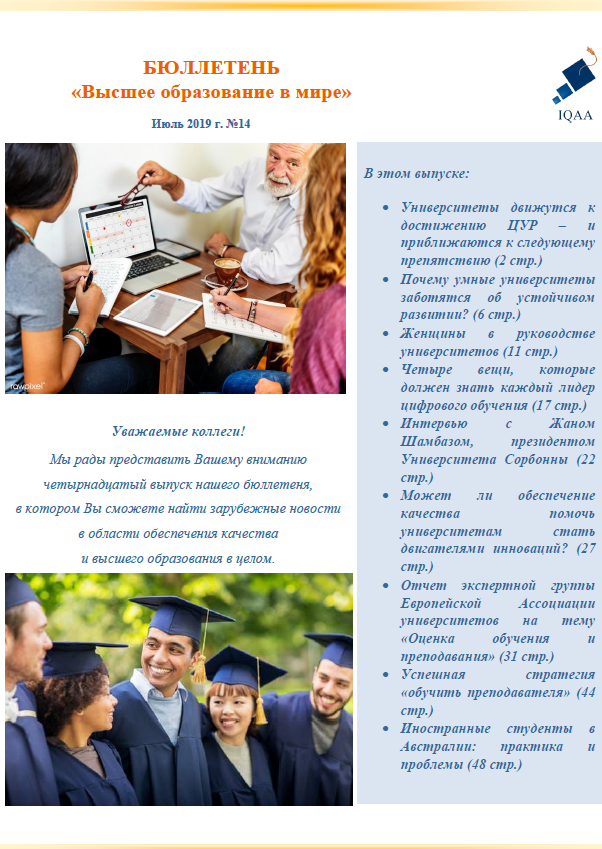
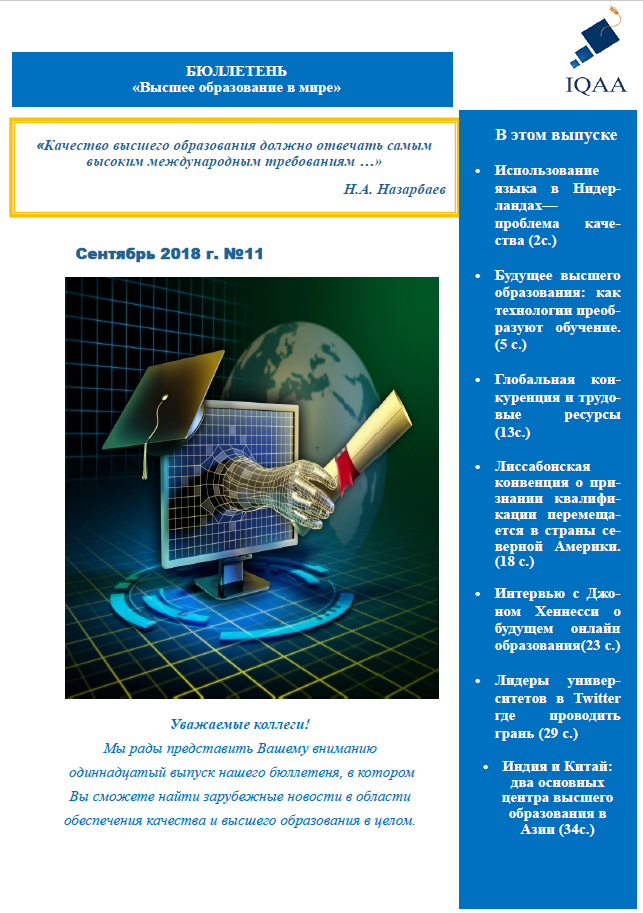



VIDEO ARCHIVE
VII Eurasian Forum on Quality Assurance in Higher Education
(September 26, 2024)
VI Eurasian Forum on Quality Assurance in Higher Education
(October 13, 2023)
INQAAHE Conference
(May 29 - June 01, 2023)
V Eurasian Forum on Quality Assurance in Higher Education
(September 29-30, 2024)
IV Eurasian Forum on Quality Assurance in Higher Education. P.2
(October 29, 2021)
IV Eurasian Forum on Quality Assurance in Higher Education. P.1
(October 28, 2021)
II Eurasian Forum "Transformation through Digitalization: Universities and Quality Assurance"
(September 16, 2019)
IQAA
International Conference "Training of an external expert group and Preparation of reports" (October 15, 2018)
I Eurasian Forum on Quality Assurance in Education (September 20-21, 2018)
IQAA International Training Seminar (October 05, 2017)
What is accreditation?
The role of students in the process of ensuring the quality of education
Quality assurance procedure in educational institutions
Seminar "New Challenges for Higher Education in the 21st century: implications for quality assurance"
IQAA International Conference (Part 3)
IQAA International Conference (Part 2)
IQAA International Conference (Part 1)
PROGRAMME (SPECIALIZED) ACCREDITATION
Programme (specialized) accreditation is an assessment of the quality of individual educational programmes implemented by an educational organization, designed to assess the level of compliance of the programme with the quality of the profession for which this programme prepares graduates. Accreditation of educational programmes consists of an official examination conducted by the accreditation agency in order to determine whether the training for these programmes meets the accepted standards and requirements.
The quality assurance system is evaluated in accordance with the IQAA quality standards by external experts who offer an objective view of the approaches and mechanisms for quality assurance and programme development. Accreditation is designed to play the role of a guarantor of the quality and reliability of the organization of education according to accredited educational programmes, to create trust on the part of applicants and their parents, and recognition by employers of the validity of the education received by graduates.
The standards for accreditation of higher education programmes are developed in accordance with the Law of the Republic of Kazakhstan "On Education", the European Standards and Guidelines for Quality Assurance of Higher Education (ESG) and the international practice on accreditation of higher education programmes.
The standards of accreditation of higher education programmes are based on generally recognized key concepts: the responsibility of higher education institutions for providing quality education, taking into account and protecting the interests of society, stakeholders and, first of all, students in obtaining quality educational services, compliance of higher education programmes with social and professional competencies, meeting the educational needs of individuals and society in obtaining a profession.
Standards of Programme (Specialized) Accreditation of Higher Education Organizations (2021)
The standards of specialized accreditation of postgraduate training of doctors in residency are developed in accordance with the Code "On the Health of the People and the Health System"; the Laws of the Republic of Kazakhstan "On Education", "On Technical Regulation"; regulatory documents of the Ministry of Health and Social Development of the Republic of Kazakhstan; International standards of the World Federation of Medical Education for Improving the Quality of Postgraduate Medical Education, European standards and guidelines, taking into account the national and regional needs and priorities of the health system of Kazakhstan.
Postgraduate medical education-residency, is the base of medical training, during which doctors gain experience after completing basic medical training. In accordance with the Law of the Republic of Kazakhstan "On Education" (No. 319-3 of 27.07.2007, Article 22), the development of a professional training programme of residency is a prerequisite for admission to clinical practice of citizens who have received higher medical education in clinical specialties.
INITIAL PROGRAMME ACCREDITATION
Initial programme accreditation (ex-ante) of higher education institutions – a procedure for assessing the quality of an educational programme (licensed by the state for educational activities under the programme) without graduates and employers for compliance with the declared status and standards of the accreditation body.
The initial accreditation status of an educational programme is granted when the proposed or developed programme demonstrates its potential to meet the IQAA accreditation standards developed on the basis of the ESG.
Initial institutional accreditation provides for all procedures for conducting an external audit in accordance with the standards and criteria for institutional accreditation of the educational organization/educational programme, with the exception of interviews with graduates and employers, and the implementation of the recommendations of the expert group after obtaining the status of initial accreditation.
Accreditation is carried out annually before the first graduation of students. The decision on the initial accreditation of educational programs is made:
- Accredit for 1 (one) year with an annual check of the educational program before the first graduation of students;
- Don't accredit.
INSTITUTIONAL ACCREDITATION
Institutional accreditation is the process of assessing the quality level of an educational institution in accordance with the declared status. In the process of institutional accreditation, the quality of education and the scientific activities of the educational organization are evaluated.
The IQAA institutional accreditation standards are developed in accordance with the "Standards and Guidelines for Quality Assurance in the European Higher Education Area" (ESG) and are intended for the internal quality assurance system of higher education institutions.
The standards and criteria for institutional accreditation of higher education institutions are developed in accordance with the Law of the Republic of Kazakhstan "On Education", the European Standards and Guidelines for Quality Assurance of Higher Education (ESG), the requirements of the Bologna Process, international practice on institutional accreditation and audit of higher education.
The standards and criteria of institutional accreditation are intended for internal quality assurance of higher education institutions.
The standards and criteria for institutional accreditation are based on four key ESG principles:
1.Higher education institutions are fully responsible for the quality of the provision of educational services and ensuring their quality.
2.Quality assurance is consistent with the diversity of higher education systems, universities, educational programs, and students.
3.Quality assurance supports the development of a quality culture.
4.Quality assurance takes into account the needs and expectations of students, all other stakeholders, and society.
Standards for Institutional Accreditation of Higher Education Organizations (2021)
INITIAL INSTITUTIONAL ACCREDITATION
Initial institutional accreditation (ex-ante) of higher education institutions – the process of assessing the quality of the organization of higher education (licensed by the state for educational activities) without the release of students for compliance with the declared status and standards of the accreditation body.
The initial accreditation status of an educational organization is granted when the educational organization demonstrates its potential to meet the IQAA accreditation standards developed on the basis of the ESG.
Initial institutional accreditation provides for all procedures for conducting an external audit in accordance with the standards and criteria for institutional accreditation of the educational organization/educational program, with the exception of interviews with graduates, employers, and students and the implementation of the recommendations of the expert group after obtaining the status of initial accreditation.
CONTACTS

Our address:
20 Dostyk Street, Business Center "Saint Petersburg", office 801,
Astana, Z05H9M7, Republic of Kazakhstan
Phone / fax: +7 (7172) 27-38-20
E-mail: This email address is being protected from spambots. You need JavaScript enabled to view it.
Secretariat: +7 (7172) 27-38-20 E-mail: This email address is being protected from spambots. You need JavaScript enabled to view it.
Accountant: +7 (7172) 27-38-21 E-mail: This email address is being protected from spambots. You need JavaScript enabled to view it.
Jurist: +7 (7172) 27-24-90 E-mail: This email address is being protected from spambots. You need JavaScript enabled to view it.
INTERNATIONAL DOCUMENTS
The standards and guidelines for Quality Assurance in the European Higher Education Area (ESG) were adopted by the Ministers of Education in 2005 following a proposal prepared by the European Association for Quality Assurance in Higher Education (ENQA) in cooperation with the European Union of Students (ESU), the European Association of Higher Education Institutions (EURASHE) and the European Association of Universities (EUA).
Since 2005, significant progress has been made in the area of quality assurance, as well as in other areas of the Bologna Process.
In response to this change in context, the 2012 ministerial communique called on the E4 Group (ENQA, ESU, EUA, EURASHE), in collaboration with international education organizations, Business Europe and the European Register for Quality Assurance in Higher Education (EQAR), to draft a revised ESG "with a view to improving their clarity, applicability and usefulness, including the scope of application".
The development of the new version of the ESG included several rounds of consultations involving both key stakeholders and ministries. All comments, suggestions and recommendations received were carefully reviewed and taken into account by the Steering Group (WG). They are reflected in the final version of the standards and guidelines for quality assurance in the EHEA (ESG). The new ESG standards were adopted at the 2015 Conference of Ministers of Higher Education in Yerevan, Armenia.
The original new ESG 2015 document is available at the website ENQA and presented below: ENQA 2015 Standards and Guidelines
ECTS (European Credit Transfer and Accumulation System) was introduced in 1989 as part of the Erasmus program as a way to transfer loans received by students abroad upon their return to their original higher education institutions. Currently, this system plays an additional role in the accumulation of loans, the development, description and implementation of programs, facilitating the mobility of students within different countries through the process of recognizing loans and study periods. The ECTS Usage Guide provides recommendations for implementing ECTS and links to useful supporting documents.
The 2009 ECTS Guidelines were revised by the Bologna Process Working Group (BFUG) on 27-28 November 2014 in Rome and were approved at the May 2015 Ministerial Conference in Yerevan, Armenia. This revised version is based on the work carried out in recent years, developed in the countries of the Bologna Process, and in the individual countries. This was done to help the academic community and other stakeholders in the higher education move towards the changes promoted by the Bologna Process.
The revised guidelines take into account recent developments in the Bologna process, such as the creation of the European Higher Education Area (EHEA), the consolidation of continuing education, the paradigm shift from the teacher-centered to student-centered higher education, the increasing use of the concept of learning outcomes, and the development of new forms of learning and teaching.
This information is taken from the official ECTS User Guide.
More information about the European Credit Transfer and Accumulation System (ECTS) is available on the official website of the European Commission.
INQAAHE Good Practice Guide (International Network of Quality Assurance Agencies in Higher Education) is intended for use in the work of all quality assurance agencies, regardless of their stage of development. The original INQAAHE Good Practice Guide was published in 2003 and revised in 2006. The new version of the INQAAHE Good Practice Guide reflects the experience of institutions, programmes and experts who used the 2003 version. It is designed to continue the process of continuous improvement of INQAAHE.
The purpose of the Good Practice Guide is to promote good practices for internal and / or external quality assurance. Specific goals include:
- creating a framework for guiding the creation of new external quality assurance agencies (EQAAs);
- providing criteria for use in self-assessment and external evaluation of external quality assurance agencies;
- promotion of professional development among external quality assurance agencies and their employees;
- promoting public accountability of external quality assurance agencies.
This information is taken from the official INQAAHE Good Practice Guidelines.
More information about the INQAAHE Good Practice Guide is available on the official INQAAHE website.
Lisbon Recognition Convention (The Convention on the Recognition of Qualifications Relating to Higher Education in the European Region) was developed by the Council of Europe and UNESCO and adopted by the national representatives in Lisbon on 11 April 1997. It provides for the creation of a coherent and consistent framework for the recognition of relevant qualifications in the higher education system. The purpose of creating this document is to ensure that the qualifications of a signatory from one country can be recognized in another country.
The basic principles of the Lisbon Recognition Convention are presented below:
- Holders of qualifications issued in one country should have adequate access to the assessment of these qualifications in another country.
- Each country must recognize qualifications issued by other countries that meet the general requirements for access to higher education, in order to access the programs that make up its higher education system, unless it can be proved that there are significant differences between the general requirements and the qualifications for which recognition of this qualification is requested.
Recognition of a higher education qualification issued in another country must entail one or more of the following consequences:
- access to further education in higher education, including relevant examinations, and / or to the training in degree programmes, under conditions similar to those applicable to the holders of candidate qualifications in the country in which recognition is sought;
- use of the degree in accordance with the laws and regulations of the country in which recognition is sought;
- in addition, recognition can facilitate access to the labor market.
This information is taken from the official document of the Lisbon Convention on Recognition.
More information about the Lisbon Recognition Convention is available on the official website of the Council of Europe.
REGULATORY AND LEGAL DOCUMENTS OF THE REPUBLIC OF KAZAKHSTAN
Education is recognized as one of the most important priorities of the long-term Strategy "Kazakhstan-2050". The overall goal of educational reforms in Kazakhstan is to adapt the education system to the new socio-economic environment. The President of Kazakhstan also set the task of making the republic one of the 30 most competitive countries in the world. Improving the education system plays an important role in achieving this goal.
The organizational basis for the implementation of the state policy of the Republic of Kazakhstan in the field of education is the State Program for the Development of Education of the Republic of Kazakhstan, which provides the state policy and modernization of Kazakhstan's education.
The program is a complex of interrelated activities in terms of resources and terms, covering changes in the structure, content and technologies of education and upbringing, the management system, the organizational and legal forms of the subjects of educational activity and financial and economic mechanisms.
More...
ADDITIONAL EDUCATION
Additional professional education is aimed at meeting the educational needs throughout life in order to obtain an additional amount of knowledge and skills in accordance with the ongoing socio-economic changes in society.
Additional adult education is provided by the educational organizations, as well as the legal entities that have structural divisions that implement additional educational programs.
In the process of institutional accreditation, the quality of education and the scientific activity of the educational institution is evaluated. The IQAA standards and criteria for institutional accreditation are developed in accordance with the Standards and Guidelines for Quality Assurance in the European Higher Education Area (ESG) and are intended for the internal quality assurance of the educational institution.
Through accreditation, the educational institution has the opportunity to receive an independent expert assessment and measures to further improve its activities.
The accreditation procedure of the educational program is carried out by independent international and national experts in accordance with the Standards and criteria of the IQAA program accreditation and covers all aspects of the educational program.
After receiving accreditation, the Agency annually conducts post-accreditation monitoring (PAM). Educational institutions must submit an annual report to IQAA on the changes and achievements that have occurred during the year in order to carry out continuous monitoring of activities and periodic evaluation of educational programs. Periodically and selectively, monitoring is carried out with a visit directly to the educational organization. All procedures for post-accreditation monitoring are prescribed in the Regulations on Post-accreditation Monitoring.
Thus, by promoting high quality in education, the Agency provides an opportunity for educational organizations to eliminate the identified inconsistencies and improve their activities.

EXPERTS
In the external assessment of the quality of educational institutions or their educational programs, the determining role belongs to the experts, who have extensive experience in professional fields and contribute to the work of the Agency. Experts are specialists with an academic degree who understand the essence of the phenomenon being evaluated. The expert evaluation mechanism focuses on internal quality indicators and is based on the principles of integrity of the self-managed academic community. In addition to local experts, each accreditation includes an international expert, who is called upon to provide an outside view and evaluate the educational organization or its program from an international perspective.
From the very beginning of its activity, IQAA has always involved students, employers, and international experts in all external audits, which allows all interested parties to participate in quality assurance procedures, as well as to learn from international experience.
IQAA focuses on training and systematically improving the skills of its external experts through training seminars, conferences, and the development of training materials.
The "Experts" tab is created specifically for external experts of the Agency, as well as potential persons wishing to become IQAA experts among national experts, international experts, representatives of employers, and students. The information and materials presented in this section serve as the basis for the effective work and self-development of external IQAA experts. Information for experts is constantly updated and improved in accordance with new trends in the field of quality assurance.
ACCREDITATION OF HIGHER AND POSTGRADUATE EDUCATION
The IQAA accreditation standards are developed in accordance with the Standards and Guidelines for Quality Assurance in the European Higher Education Area (ESG) and are intended for internal quality assurance of educational institutions. The accreditation procedure also takes into account state regulatory documents and international standards.
The IQAA accreditation procedure consists of 4 stages:
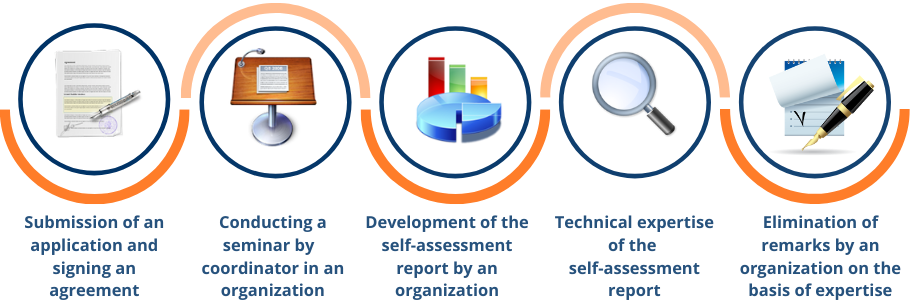
- submission by the educational organization of an application for accreditation to the Agency with a brief description of the organization's activities and copies of the general license;
- signing of an accreditation agreement between IQAA and the educational organization. The contract specifies the rights and obligations of the parties, the cost of the procedure, the terms of accreditation, including the stages of the process. In the case of state organizations, it is possible to sign the contract only after conducting the public procurement procedure on the electronic portal;
- appointment of a coordinator, preliminary visit to the organization, if the Agency is working with him for the first time;
- conducting training seminars for the organization's working groups on the preparation of the self-assessment report and the implementation of the accreditation procedure;
- conducting a self-assessment procedure by an educational institution, compiling a self-assessment report in accordance with IQAA standards and criteria;
- submission of the first version of the self-assessment report and technical expertise. The results of the examination are sent to the university, if necessary, the self-assessment report is finalized by the educational organization;
- submission of the final self-assessment report and its annexes to the Agency;
- preliminary audit during institutional accreditation.
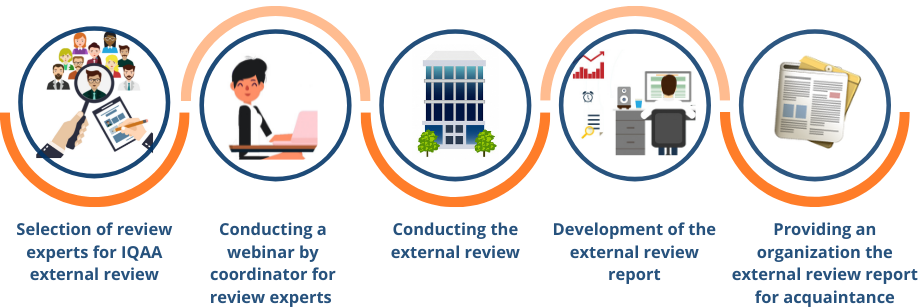
- IQAA forms a competent group of experts (auditors), which includes representatives of educational institutions of Kazakhstan, an employer, a student and an international expert;
- the group is formed in parallel during the examination of the self-assessment report;
- the agency informs the educational institution about the composition of the external audit group. If the educational organization suspects a conflict of interest among any of the auditors, the organization has the right to apply to the Agency to replace the expert (auditor), attaching a written reasoned explanation;
- the coordinator sends the self-assessment materials and methodological support several weeks in advance to the members of the expert group to prepare for the external audit;
- the coordinator conducts a preliminary webinar for the expert group in order to train experts and discuss organizational audit issues, and immediately before the start of the visit to the educational institution - a briefing;
- external audit to the educational organization (3 days). An external audit is conducted to assess the reliability of the information provided in the self-assessment report, the actual state of affairs in the organization;
- the expert group generates an external evaluation report (with comments, recommendations for improvement, and good practices), which is sent to the coordinator;
- the IQAA coordinator sends the received report of the expert group on the evaluation of the organization's activities to the educational organization to eliminate factual inaccuracies, if any;
- if necessary, the complaint procedure is available to educational institutions.
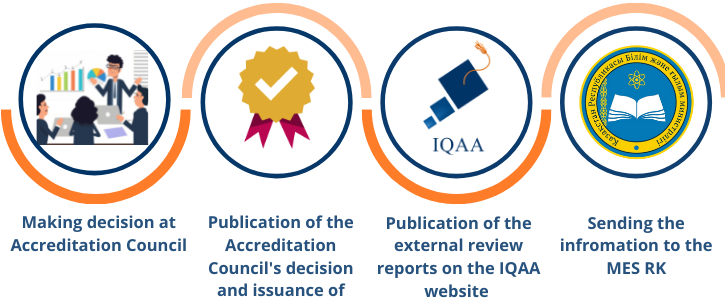
- the Department for checking the reports of the EEG and PAM, together with the expert council, checks and edits the external audit report and forms an accreditation conclusion for the Accreditation Council;
- based on the self-assessment report, the external audit report and the conclusion, the Agency coordinator prepares a presentation for the Accreditation Council;
- holding a meeting of the IQAA Accreditation Council and making a decision on the accreditation of the educational institution. The Accreditation Council independently makes decisions based on the self-assessment report and the external audit report, presentation and conclusion. However, taking into account the opinions of the members of the Accreditation Council, additional information and evidence base for the educational institution, the assessment may be changed;
- informing the educational institution and the members of the expert group that conducted the external audit about the decision on accreditation;
- if necessary, the appeal procedure is available to universities;
- publication of the external audit report and accreditation results on the Agency's website. Inclusion of an accredited educational organization in the IQAA register on the website "Register of Decisions and Reports";
- publication of the external audit report in the DEQAR database;
- sending information to the Ministry of Education and Science of the Republic of Kazakhstan for inclusion of an accredited university in the relevant National Register.
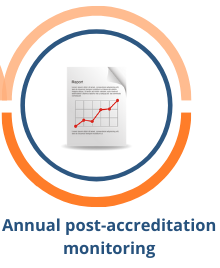
- Implementation of regular post-accreditation monitoring by the Agency.
HIGHER EDUCATION QUALITY ASSURANCE IN KAZAKHSTAN
Since 2011, thanks to the reforms undertaken in the field of quality assessment of higher education, the role of accreditation as one of the main tools for improving the quality of educational services has been significantly strengthened. According to Article 9-1 of the "Law on Education" of the Republic of Kazakhstan, accreditation is carried out voluntarily by non-profit non-governmental organizations. The educational organization independently selects the accreditation body. The State reserves the right to regulate accreditation providers by recognizing and including them in the National Register of Accredited Bodies.
National and international accreditation agencies in Kazakhstan are guided by the Standards and Guidelines in the field of quality assurance of higher education in the European Area (ESG — European Standards and Guidelines), approved by the largest European association for quality assurance of higher Education - ENQA (European Association for Quality Assurance in Higher Education).
Harmonization of external and internal quality assessment procedures with international and European standards, as well as membership of accreditation bodies in ENQA – the way to the recognition of the Kazakh education system at the European level.




 Ministry of Science, Higher Education and Innovation of the Kyrgyz Republic