APPLY TO BECOME AN EXPERT
To be included in the database of experts in preschool and secondary education, please send your CV to This email address is being protected from spambots. You need JavaScript enabled to view it..


In the external evaluation of the quality of educational institutions or their programs, the decisive role belongs to experts with extensive professional experience, who contribute their expertise to the work of the Agency.
The IQAA agency regularly conducts expert training. During seminars, IQAA provides detailed guidance on working in expert teams, introduces standards and criteria for internal quality assurance of educational organizations, as well as external evaluation standards and methodological materials.
The expert pool brings together leading specialists in the field of education — practitioners with strong professional reputations and a deep understanding of modern educational processes. This includes experienced teachers, methodologists, and administrators from top schools in the country who have experience participating in international accreditation.
Each expert has significant professional experience and verified qualifications, ensuring a high level of expertise at all stages of the accreditation process. This allows experts not only to objectively assess the activities of educational organizations but also to provide practical, actionable recommendations that support strategic development, improve education quality, and help institutions meet international standards.
The system for training and selecting experts meets the requirements of authorized bodies. Expert teams must include international specialists, with at least one foreign expert. Experts hold academic degrees (Candidate of Sciences, Doctor of Sciences, PhD, or specialized doctoral degrees) and/or are recognized members of professional communities with experience in institutional and specialized accreditation. This ensures that accreditation procedures comply with the best international practices and standards.
To be included in the database of experts in preschool and secondary education, please send your CV to This email address is being protected from spambots. You need JavaScript enabled to view it..
Сіздің кандидатураңызды мектепке дейінгі және орта білім беру бойынша сарапшылар базасына қосу үшін түйіндемеңізді This email address is being protected from spambots. You need JavaScript enabled to view it. электрондық поштаға жіберіңіз.
Для включения вашей кандидатуры в Базу экспертов по высшему и послевузовскому образованию, отправьте свое резюме на электронную почту This email address is being protected from spambots. You need JavaScript enabled to view it..
Для включения вашей кандидатуры в Базу экспертов по дошкольному и среднему образованию, отправьте свое резюме на электронную почту This email address is being protected from spambots. You need JavaScript enabled to view it..
IQAA agency's threshold requirements for preschool and secondary education organisations to participate in the institutional accreditation procedure were approved by the Order of the President IQAA.
Accreditation of preschool or secondary education organizations is divided into 3 stages.
Preliminary steps
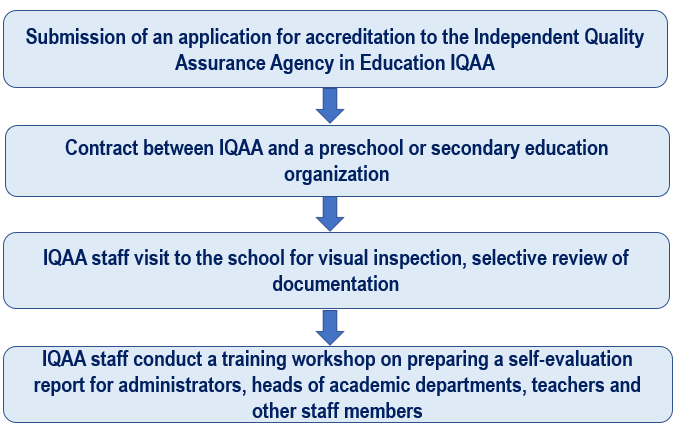
Stages of school self-evaluation
The main principles to be taken into account by secondary education organizations when writing a self-evaluation report:
External evaluation procedure:
The program of the external expert group's school visit includes:
1. Consideration by the Accreditation Council of the school's accreditation materials.
2. The Accreditation Council makes a decision on accreditation of a secondary education organization.
3. In case of successful accreditation - registration and issuance of a certificate of accreditation of a secondary education organization for the relevant term.
The Independent Quality Assurance Agency in Education (IQAA) standards were developed specifically for accreditation of preschool and secondary education, taking into account current international trends and the national Kazakhstani context. These institutional accreditation standards cover all aspects of preschool and secondary education and include the following areas:
The standards contain normative requirements, criteria for assessing the performance of preschool and secondary education and are the main document for educational organizations when preparing self-assessment reports and for experts when examining these reports and conducting external audits.
This standard defines the requirements for the school's mission, vision, values, goals and objectives, as well as the process of strategic planning and evaluation of the effectiveness of educational activities. The mission of the school should be brief and reflect its philosophy, values and role in the socio-economic development of the region. It sets the direction of the school's development for 5-10 years. An important aspect is the involvement of teaching staff, administration, parents and the local community in the process of forming the mission and goals of the school. All stakeholders should be actively involved in the discussion and approval of these elements.
Strategic planning should take into account the changing environment and priorities set by the Ministry of Education. The key is to conduct a SWOT analysis to assess the school's strengths, weaknesses, threats and opportunities in order to adjust the strategic and annual plans based on this data. In addition, the strategic plan should include elements of inclusive education to ensure equal access to education for all categories of learners, including children with special educational needs.
The school should have a clear governance structure that ensures effective management of the educational process and maintenance of a high level of learning quality. The school should have governing bodies, such as the Board of Trustees, which plays an active role in approving the strategic development plan and monitoring the implementation of educational programs. The management should ensure stability and consistency in governance, have competences to make strategically sound decisions and support the professional development of staff. Plans should be developed to ensure continuity of management, as well as a system of internal documentation that regulates the roles and responsibilities of management staff, including their qualifications and training.
An important aspect is transparency in the management selection process and maintaining openness in management issues, which builds trust and effective communication with the public. It is also a key requirement to monitor learning and educational activities and to regularly evaluate and adjust progress towards the school's goals. The school should have clear procedures for monitoring and evaluating the results of educational activities, as well as methods of correction aimed at improving the quality of education.
This standard includes requirements for the quality of teaching, the content of the learning process and the control of students' progress. The school's academic policy should include mechanisms for curriculum formation, its implementation and control over the quality of teaching. The main principles are inclusion, equality of access and relevance of educational content to ensure quality education for all students. The school should have adequate resources to implement the curriculum, including qualified teaching staff, teaching materials, technical equipment and library resources. This also applies to ensuring the availability of additional educational programs and working with the individual needs of students.
Teaching methods should take into account the cultural, age and individual characteristics of pupils and introduce differentiated approaches that are in line with the principles of inclusive education. It is important to regularly evaluate teaching performance, using data on student progress, feedback from parents and colleagues to improve teaching and learning methods. As a result, this will not only improve the quality of the educational process, but also adapt it to changing requirements.
School management must establish a system that ensures the physical, emotional and cognitive well-being of all participants in the learning process. This standard defines how the school assesses and manages safety risks and how safety and health regulations are developed and updated. It is important that the school conducts regular training sessions, trains staff and students in emergency situations and co-operates with local services to ensure safety. The standard also includes requirements for monitoring safety, reviewing documents, and establishing a system to prevent child abuse, bullying, and harassment, which contributes to a safe educational environment.
The school must have an effective access control system for visitors, volunteers and others, including registration at the entrance, CCTV and strict access rules, which helps to prevent unauthorised entry to the premises. In addition, an important element is the provision of healthy and balanced meals for students that meet hygiene and sanitary standards. Having and adhering to written instructions on the storage and administration of medication is another important consideration. The school is required to develop procedures governing the safe use of medication, including staff responsibilities and parental information policies.
It is important that the school has the necessary material and non-material assets to ensure the quality of educational services. This includes not only buildings, classrooms, laboratories and sports facilities, but also the availability of textbooks, modern information technology, and the state of technical equipment. The school should monitor the effective usage of these resources, as well as regularly assess their condition and suggest ways for improvement. The school should ensure that the infrastructure meets the requirements of the National standards and sanitary norms, including safety, accessibility and hygiene standards.
Also important is compliance with accounting standards and financial sustainability of the school. The school must demonstrate the existence of financial policies, accounting and control systems that support the long-term financial sustainability of the school and contribute to its development. Annual financial audits and the adequacy of funding to meet the needs of students and staff are also important.
Институционалдық аккредиттеуден өту үшін білім ұйымы нысанға сәйкес IQAA-ға (This email address is being protected from spambots. You need JavaScript enabled to view it. ресми электрондық поштаға) өтінім береді.
In order to undergo institutional accreditation, educational organizations have to submit an electronic version of application to IQAA (via the official e-mail This email address is being protected from spambots. You need JavaScript enabled to view it.) in accordance with the registered form.
Для прохождения институциональной аккредитации учебное заведение подает в IQAA заявку в электронном виде (на официальную электронную почту This email address is being protected from spambots. You need JavaScript enabled to view it.) согласно форме.



 Ministry of Science, Higher Education and Innovation of the Kyrgyz Republic